
Finding Superior Residents Step by Step
A useful search starts with the exact text already in hand. Keep a person's printed name, middle initial, old spelling, address, date, and county together. For an address, retain the street number, direction, suffix, unit, city, state, and ZIP. Superior is both a city and the Douglas County seat, but nearby postal addresses may fall in the Town of Superior, a village, or unincorporated land. Confirm that first. It determines whether a city or county office holds the next record.
The Superior residents directory is best treated as a set of dated source trails, not one master list. An assessment names an owner, not every person in a home. A voter tool is meant for a voter checking their own registration. A deed identifies parties to a land transfer. A city directory prints what its publisher gathered for a given year. Keep those meanings separate while following this starter path:
- Normalize the name or street address, but save the original wording.
- Search the assessment roll by Douglas County, street address, or tax key.
- Use the parcel key to check the map and recorded-document trail.
- Check a name in the appropriate court, license, business, or historical index.
- Record the source, date checked, identifier, and any conflict before drawing a conclusion.
Superior Residents Directory Offices
Several custodians support a Superior residents directory search. The City Assessor and Real Property Lister maintain the assessment side. Douglas County's Register of Deeds keeps deeds, land contracts, mortgages, military discharges, and eligible vital records. The Clerk of Courts handles circuit files, while the City Records Bureau routes city requests to the department that owns the material. Asking the named custodian for a specific record is far more effective than sending one broad request for everything about a person.
Douglas County Register of Deeds
1313 Belknap St, Room 108
Superior, WI 54880
715-395-1551
Douglas County Clerk of Courts
1313 Belknap St, Room 309
Superior, WI 54880
715-395-1203
The City Clerk is at 1316 N 14th St, Suite 200 and can be reached at 715-395-7200 on weekdays from 8:00 to 4:30. For city files, the online records request route is available, but a phone, mail, or in-person request may fit when the online system does not expose the needed file.
Superior Property Records by Address
The City of Superior links to Assessordata as its free assessment search. Its public form asks for a county and then accepts either a Property Street Address or Tax Key Number. Search the address first, copy the parcel key from a matching record, and use that key in later systems. A current card may show the situs address, an owner or mailing address, legal description, land and improvement values, class, and valuation year. None of those fields proves who sleeps at the address now.
| Search field | How Superior uses it | Limit |
|---|---|---|
| County | Select Douglas County | Separates same street names elsewhere |
| Property Street Address | Finds the parcel by situs address | Mailing address may differ |
| Tax Key Number | Links records with a stable parcel key | Copy it exactly |
The 2025 City of Superior assessment roll supplies a useful field-level sample when the live portal changes. It includes owner, tax key, property description, address, district, class, acreage, and value fields. A result can also name a trust, estate, or organization. Follow the legal description and document references instead of forcing a personal name into an entity-owned parcel.
Reading the Superior Parcel Map
The City GIS guide describes public parcel maps, property information, measuring, printing, and map layers. Beacon GIS adds the visual check: does the selected parcel shape fit the street address, and are nearby lines parcels, roads, or another boundary? The map helps orient a search and reveal adjacent parcel IDs. It is not a legal survey. Superior advises that an official boundary requires a Wisconsin-licensed surveyor.
- Parcel
- A mapped unit of land tied to a tax key.
- Situs address
- The location assigned to the property, which may differ from the owner's mail address.
- Plat
- A recorded map that lays out lots, blocks, or subdivisions.
- Index
- A finding aid that points to a record; it is not always the record image.
Superior's address points were built for emergency dispatch, law enforcement, and land-use work. An address point can exist on a vacant parcel, and its label may differ from a postal address. That makes it strong evidence that a place is recognized, but weak evidence about a resident. The detailed address chain belongs in the Superior street directory.
Douglas County Deeds and Superior Names
The Douglas County real-estate records page separates several kinds of access. LandShark requires an account, and document images involve a card-payment context. Public terminals at the courthouse offer another route. Tract-index books are not online, so old parcel work may require the counter or a focused request to Land Records. The online image cutoffs also differ by document class: deeds reach through April 1961, agreements through November 1960, tax deeds through February 1951, and corporations through September 1970.
Use the current owner or parcel key to enter the chain. Save each grantor, grantee, instrument number, recording date, document type, legal description, and prior-instrument reference. Work backward one recorded transfer at a time. A deed proves that named parties took part in a recorded transaction. It does not prove that either person occupied the parcel. When the web index stops, the tract book is the correct next source, not repeated searches with new spelling guesses.
See the LandShark entry screen used for Douglas County recorded records.
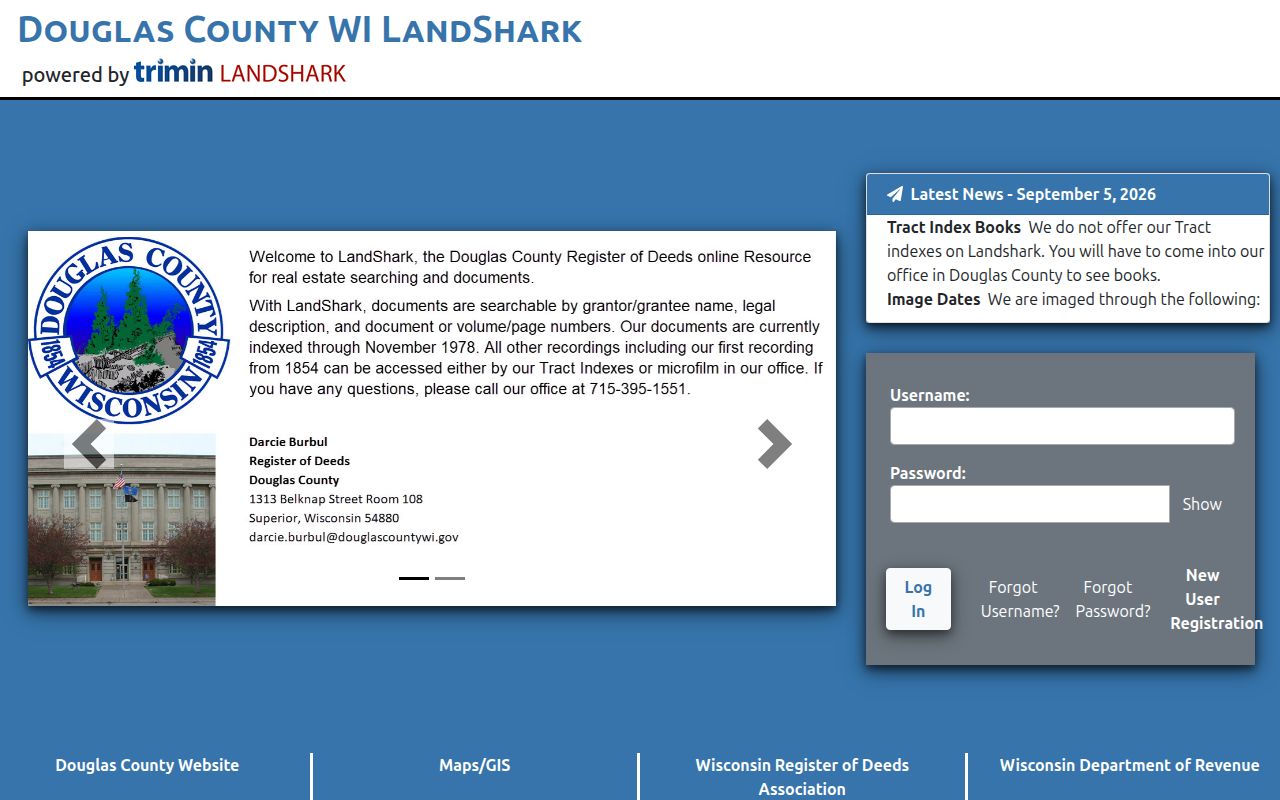
The captured screen shows the portal gateway. The county's instructions remain the key source for fees, image cutoffs, terminals, and the offline tract-book path.
Current Superior Residents Directory Sources
No single current roll covers all Superior residents. Each source answers a narrower question and has a different access rule. Use the source's own identifier to avoid blending people with the same name.
| Resident source | What it can confirm | Keeper | Access path |
|---|---|---|---|
| Assessment roll | Owner and parcel snapshot | City Assessor | Free search, office help |
| Recorded-document index | Parties and land instruments | Register of Deeds | LandShark, terminal, tract book |
| Circuit case index | Party role and case history | Wisconsin courts | WCCA, courthouse file |
| Voter information | A voter's own status and history | Wisconsin Elections Commission | MyVote or formal data route |
| Credential record | Public license status | Wisconsin DSPS | State license search |
A commercial people-finder may blend many of these categories, but it can hide the original dates and match logic. Official systems keep the custodian and record purpose visible. They may still contain errors, yet they give a reader a stable parcel number, case number, credential number, or instrument number to verify. Free access may cover an index while a copy, image, or custom request costs money.
Superior Court Records Need Context
The official Wisconsin case-search landing page links to WCCA, the statewide public circuit-court index. Search concepts include party name, birth date, business name, county, and case number. Results may show case number and type, Douglas County, filing date, parties and roles, court events, filing or order titles, status, and disposition. WCCA does not place the case documents or transcripts online. Those come from the Clerk of Courts at the courthouse.
A common surname is not enough. Match the county, case type and year, party role, case number, and event sequence. A person's appearance as a party does not show that the person lived in Superior. Municipal court is also separate, and no public Superior municipal-court search portal was located in the research. Route a specific citation or file request to the legal custodian rather than assuming the circuit index contains it.
Superior Voter Records Have Boundaries
MyVote Wisconsin is designed for a voter to check their own record with first name, last name, and date of birth. It can provide registration details, voting-history items, ballot tools, elected officials, and address-update functions. It is not a reverse-address directory. Wisconsin does not register party affiliation, so a Superior residents directory result must never invent that field.
Public voter data has a separate route through the Wisconsin Elections Commission and Wis. Stat. §6.36. Protected data includes birth dates, driver-license and Social Security numbers, Safe at Home information, and an address tied to an identification-card serial number. Poll lists may also be requested from a municipal or county clerk at reproduction cost. Current fee terms should be checked before ordering because the research did not capture a current official fee table.
The MyVote lookup form shows why this search is personal and field-specific.
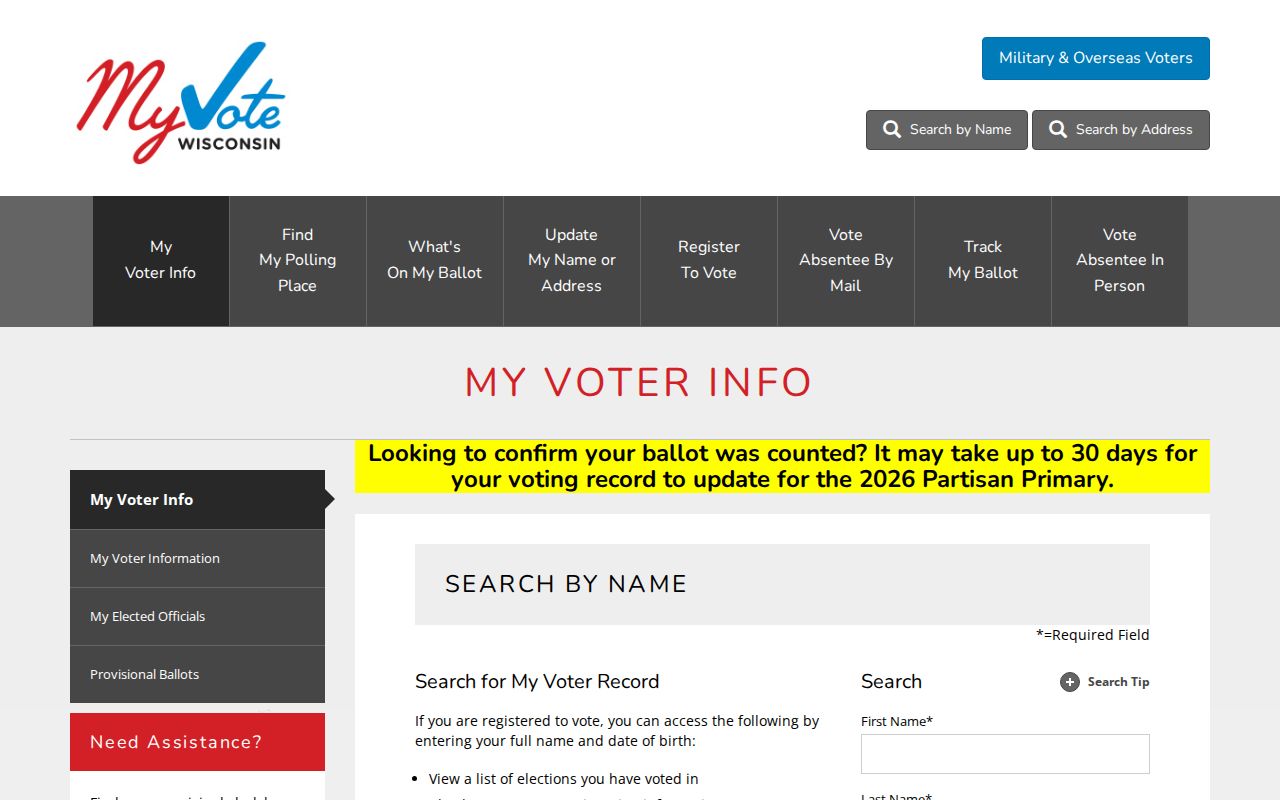
The form requests identity details from the voter. It should not be used to assemble a list of people at a Superior street address.
Requesting Superior Records Not Online
Wisconsin Public Records Law, Wis. Stat. §§19.31-19.39, covers records made or kept in connection with public business, subject to statutes, common-law limits, and a public-interest balancing test. A request does not need magic words or a required form. It must be specific enough in subject and time to be understood. A custodian should respond as soon as practicable and without delay, though the law sets no fixed number of days.
The City Records Bureau accepts requests online, in person, by mail, or by phone and routes department records. The City Archive can be searched by category, keyword, archive, time period, and start or end date. Douglas County offices provide separate paths for deeds, tax data, court files, and vital records. If a request gets no reply, keep a dated copy and follow up. Silence is not a negative result.
- Name the exact record class and Superior or Douglas County custodian.
- Give a case, parcel, instrument, date range, or other stable key.
- Ask for electronic inspection when that will meet the need.
- Request an estimate if copies, research, or location work may create a fee.
- Log the response, denial reason, redactions, and next office named.
Superior Residents Directory Through Time
The Douglas County Historical Society lists Superior city directory volumes beginning with 1889-90 and 1892-93, followed by many annual or near-annual books through 1906. Later holdings include 1914-35, 1937-55, frequent volumes from 1957-98, then 2000, 2001, and 2003. The gaps matter. A missing year in that inventory does not prove that no directory was published. It means the inspected shelf does not list one.
Superior Public Library identifies local newspapers, census rolls, directories, naturalization records, an index reaching back to the 1850s, clippings, and printed material. Requests can be made in person, by phone, email, or its research form, and are answered in order without a promised turnaround. The library also offers local-history help on Tuesdays from 10:00 to noon and Thursdays from 1:00 to 3:00, including microfilm-reader help.
Duluth Main Library provides another collection locator, with Superior directories from 1922 to 2014 for in-person use and through its library genealogy subscription. Some early books bind Duluth and Superior together. Search a shared regional title before concluding that a Superior volume is absent. The full shelf and reading method are covered in the Superior city directory.
Superior Times Bridges Missing Years
The Library of Congress records the weekly Superior Times from 1870 through 1912. Digitized pages can place a name or business in a dated legal notice, obituary, social item, or street reference when the directory shelf has a gap. Newspapers can misspell a name or repeat an old address. Save the issue date and page, then pair the item with a directory, vital index, deed, or plat.
For older vital events, the Wisconsin Historical Society explains that county registration began in 1852 but remained weak until about 1880. The state table starts Douglas County marriages in 1854, births in 1861, and deaths in 1877. An index may identify an event without giving a full residence. Treat any link from that event to a present parcel as an inference until a deed, directory, map, or other dated bridge supports it.
The local Historical Society's own story also warns against reading archive gaps too strongly. An account from 1902 said there was no collection and meetings occurred only every four years. The group reorganized in 1931 and broadened countywide in 1934. Early absence may reflect what was preserved, not who was in Superior.
Superior Identity Checks Beyond Addresses
A business or credential can clarify a name without implying a home address. The Wisconsin Department of Financial Institutions corporate search covers current and historical entity filings. Search results may show a legal entity name, status, entity type, filing date, state, registered office, and filing history. It does not promise every member, trade name, phone number, or federal tax number. Use the entity ID and filing date to separate organizations with similar names.
The Wisconsin Department of Safety and Professional Services searches individuals, organizations, and trades credentials. Trades search can include credential type, status, ZIP, and name. Status is refreshed hourly and is generally current within a day. Keep profession, credential number, status, grant or expiration details, and discipline links attached to the result. A professional mailing or business address should not be relabeled as a Superior home.
Custody and registry searches demand even more care. The Douglas County Sheriff roster covers current, latest, and released jail records, while Wisconsin DOC covers the state prison population. The sex-offender registry has its own statutory scope and warns against harassment. A roster or registry entry is not a citywide resident roll and should remain in its original category.
Keep Superior Directory Findings Auditable
Every useful finding needs a small record card. Save the category, subject name as printed, any justified normalized name, address as printed, normalized address, parcel or tax key, jurisdiction, source title and URL, publication or event date, coverage period, record identifier, access status, and checked date. Add a privacy flag when a source contains protected or sensitive material. Confidence should be stated as consistent, plausible but unconfirmed, or not enough evidence.
Use stable keys before comparing text: parcel key, instrument number, case number, credential number, vital index volume or page, and directory year or page. If two sources disagree, mark the conflict. The assessor may hold a situs address while the deed uses a legal description and the owner receives mail elsewhere. An old directory may preserve a prior street form. Do not average these values or silently choose the newest.
Safe at Home is a firm boundary. Participants are confidential electors, and agencies use an assigned address while protecting the actual one. Adoption, juvenile, victim and witness, sealed-court, driver, and recent vital records also have limits. A failed search must never become an attempt to work around those protections. That discipline keeps a Superior residents directory useful for family history, civic research, estate questions, and personal record checks without turning scattered public files into an unsafe profile.