
Superior Directory Years and Repositories
Superior city directory research begins with an uneven but substantial local run. The Douglas County Historical Society collection index identifies Superior volumes from 1889 through 2003, with gaps rather than a book for every year. Some volumes are city-only, while others combine nearby places or business and household listings. The Superior Public Library and Duluth Public Library add other ways to reach the same period. Always record the repository as well as the year because two copies can differ in supplements, binding, or condition.
| Collection | Years | Where Held | Access |
|---|---|---|---|
| Superior city directories | 1889-2003, with gaps | Douglas County Historical Society | Onsite; copying or scanning may be available |
| Duluth and Superior bound volumes | Late 1800s into the 1900s | Duluth Public Library | Collection locator and library access |
| City directories, census, and newspapers | Varies by source | Superior Public Library | Local-history help and microfilm |
| Superior Times | 1870-1912 | Library of Congress | Free online newspaper images |
The Historical Society index is a holdings list, not proof that publication occurred every missing year. Its early institutional history also matters: a 1902 account reported no collection, and the society reorganized in the 1930s. That history helps explain why absence from the shelf can be a preservation issue. When a year is missing, move to a neighboring directory, newspaper, census, naturalization file, plat, or deed instead of treating silence as proof that a resident had left Superior.
Reading Superior Volumes in Person
The Superior Public Library research request service identifies local newspapers, census rolls, city directories, and naturalization records among its reference sources. A 2026 library notice also described Tuesday and Thursday drop-in local-history help with instruction on using the microfilm reader. Confirm the current schedule before traveling, then bring a short list of names, dates, and spelling variants. Staff can point to a source, but a focused question is more useful than a request for everything about one family.
The Douglas County Historical Society offers onsite archival use and notes that material held in public trust cannot be borrowed. Copies or scans may be possible, but its research-request status should be checked in advance. Duluth Public Library is also important because some bound directories cover Duluth and Superior together. That cross-river filing quirk can hide a Superior entry from a title-only catalog search.
The library research page shows the available request route and source categories.
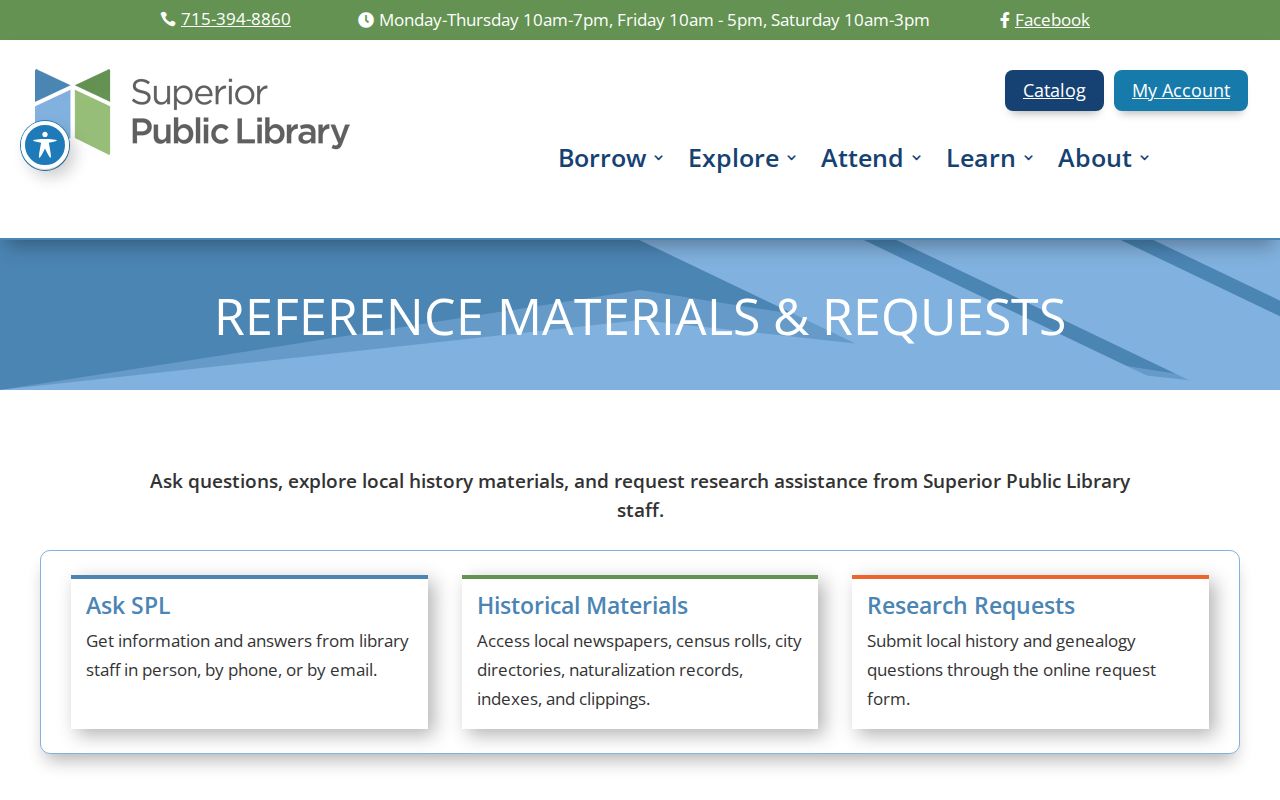
The captured page is a useful starting screen, but current hours and service terms should still be confirmed directly.
Superior City Directory Timeline
The local sequence works best as a timeline rather than a promise of annual coverage. It joins printed directories with newspaper and library sources that can account for years between books.
| Period | Useful Superior source |
|---|---|
| 1870-1912 | Superior Times supplies dated notices, addresses, business items, obituaries, and social news. |
| 1889-1906 | The earliest identified local city directory run begins within the Historical Society holdings. |
| 1907 onward | Directories can be paired with state vital records and later census years, subject to access rules. |
| Through 2003 | The Historical Society index reaches modern printed directory years, with documented gaps. |
A timeline also guards against false continuity. A person listed in one Superior city directory may have moved before the next edition was compiled. Keep the publication year beside every name and address.
Decode a Superior Directory Entry
A Superior city directory entry compresses a household into a narrow line. Copy the printed text before expanding abbreviations. The name may be a householder, worker, spouse, widow, boarder, or business contact. Occupation and employer can distinguish common names, but neither proves a home address. Page headers and front-matter keys matter because notation changed across publishers and years.
| Printed name | Preserve initials, spelling, and any spouse or widow notation exactly. |
|---|---|
| Work line | An occupation or employer helps separate people who share a name. |
| Address | Keep the house number, directional, street spelling, and any residence or boarding mark. |
| Household clue | Some volumes distinguish a householder from other adults at an address. |
| Business listing | A firm address may be separate from the person's residence line. |
- Criss-cross directory
- A later directory section arranged by street and house number rather than by surname.
- Householder index
- A list focused on the person identified as the main householder, which may omit other occupants.
- Abbreviation key
- The publisher's legend for short forms and symbols, often placed near the front of the book.
Photograph or transcribe the abbreviation key with the entry. Without it, a short mark can be mistaken for ownership, residence, or family status.
Superior Times Fills Directory Gaps
The digitized Superior Times collection covers 1870 through 1912 and can bridge years missing from a city directory shelf. Search a surname with a street, employer, church, legal notice, or business name. A dated advertisement may place a firm on a block, while an obituary or social item can connect relatives. Newspapers repeat errors and often shorten street names, so retain the issue date and page and seek a second source.
This is especially helpful before the earliest identified directory volume. It can also explain why a name vanished between editions. A death notice, business closure, travel item, or property notice supplies context, but it should not be converted into a claim of continuous residence.
Note: Search printed initials and surname variants because optical text recognition often misses worn type, columns, and old abbreviations.
Check Superior Streets Across Years
An old directory address should remain exactly as printed. Then compare it with a dated plat, deed, current parcel map, and the City Archive. Superior has an official address-point layer, but no verified citywide renumbering chronology was found. A difference between an old book and a modern map is therefore a research question, not automatic proof that the street was renamed.
The Historical Society archive-box index names atlas and plat books in Box 25, deeds and abstracts in Box 79, and public works material in Boxes 88 and 207. Those sources can connect a printed house number to a tract or public project. The Superior City Archive can also be searched by keyword, archive, category, and date range for council, planning, zoning, and public works records.
Superior Records Beside Directories
Directories become stronger when paired with records created for a different purpose. Census rolls can show a household at a ten-year interval. Naturalization papers may clarify a name form or date. Pre-1907 Wisconsin Historical Society vital indexes can add county, event date, volume, page, reel, and sequence. Cemetery registers and obituaries may close a family trail, while deeds and plats test whether the address and parcel align.
- Use census rolls to compare household members near a directory year.
- Check naturalization collections for spelling and identity details.
- Use vital indexes as leads, respecting certificate eligibility rules.
- Compare a parcel or legal description before joining old and modern addresses.
- Prefer the cemetery operator's register when correcting a burial detail.
The point is corroboration. A directory line is direct evidence of what the publisher printed, not proof of ownership or an unbroken life history.
Trace Families in Superior Directories
Family history work in Superior city directories should follow one named person through time and preserve each uncertainty. Begin with a volume near a known marriage, birth, death, census, or property event. Then work outward by year. Spouse names, occupations, and street numbers can separate similar entries, while disappearance from a volume merely triggers another search.
- Locate the closest available volume and copy the full entry, page, title, repository, and publication year.
- Check the prior and next available volumes, noting address, spelling, occupation, spouse, and business changes.
- Use a criss-cross section, when present, to test the address from the street side.
- Pair directory findings with census, newspaper, naturalization, deed, or vital-index evidence.
- Close the trail with an obituary or cemetery record only when dates and family links agree.
A missing name can mean a move, death, marriage-name change, omission, late publication, or unavailable volume. Search the address, spouse, employer, and surname variants before choosing an explanation. For a modern one-person check, move from the historical shelf to the Superior resident lookup workflow rather than treating an old listing as current.
Log Every Superior Directory Match
A compact source log prevents later guesses. Record the directory title, year, publisher when shown, repository, page, subject name as printed, address as printed, expanded abbreviations, and the date the volume was checked. Add a separate normalized name or modern address only when evidence supports it. Label that field as an interpretation.
When sources conflict, keep both readings. A directory, newspaper, deed, and census were created at different times for different aims. The strongest conclusion states exactly what each source shows and which link remains uncertain.
Keep the snapshot dated. A Superior city directory can support family and place history, but it cannot establish who lives at an address now.