
Superior Resident Lookup Source Map
A one-person search should begin with the record that fits the question. In Superior, ownership, court activity, voter self-service, vital events, and credentials belong to different custodians. A hit confirms only what that system was built to record. The table separates those purposes and the access channels available when a web portal does not answer the question.
| Record | What It Confirms | Where to Search | Access |
|---|---|---|---|
| Assessment roll | Parcel owner, mailing field, tax key, valuation date | Assessordata and City Assessor | Free portal, PDF rolls, or office help |
| Voter self-lookup | A voter's registration tools and election information | MyVote Wisconsin | Name and date of birth; protected data withheld |
| Circuit case index | Party role, case number, dates, status, and disposition | WCCA and Douglas Clerk of Courts | Free index; file copies at courthouse |
| Vital records | A qualifying birth, death, marriage, or divorce event | Wisconsin DHS, local Register of Deeds, WHS | Mail, vendor, eligible office, or historical index |
| Credentials and entities | License status or legal business filing | DSPS and Wisconsin DFI | Free public search |
Start with the most stable key available. An exact parcel number, case number, credential number, or vital-index reference is stronger than a surname. If only a name is known, add a middle initial, date, Douglas County connection, street, spouse, or documented role. An assessor owner may be an estate, trust, firm, or nonresident owner, so that field cannot establish who occupies the parcel.
Look Up Superior Court Parties
Wisconsin Circuit Court Access, often called WCCA or CCAP, is the public statewide circuit-case index. Historical official fields include party last, first, and middle name, birth date, business name, county, and case number. Results may show party roles, case type and number, filing date, hearings, filings, orders, status, and disposition. A January 2026 redesign added clearer case history and related cases, so current screen labels may differ from older instructions.
| Search field | Best use | Identity caution |
|---|---|---|
| Party name | Find cases for one spelling or variant | Common names can return unrelated parties |
| Birth date | Narrow a known person when the field is available | Full sensitive data is not broadly displayed |
| Business name | Separate an entity from an individual | A business case does not prove a home address |
| County | Limit results to Douglas County | A case in Superior does not prove residence |
| Case number | Return to a known docket | Verify year, county, and party role |
The index is not the court file. Documents, transcripts, and some copies generally require the Douglas County Clerk of Courts at 1313 Belknap Street, Room 309, or the courthouse WCCA terminal. The office handles civil, criminal, traffic, divorce, and small-claims records.
The WCCA capture shows the official public search entry.
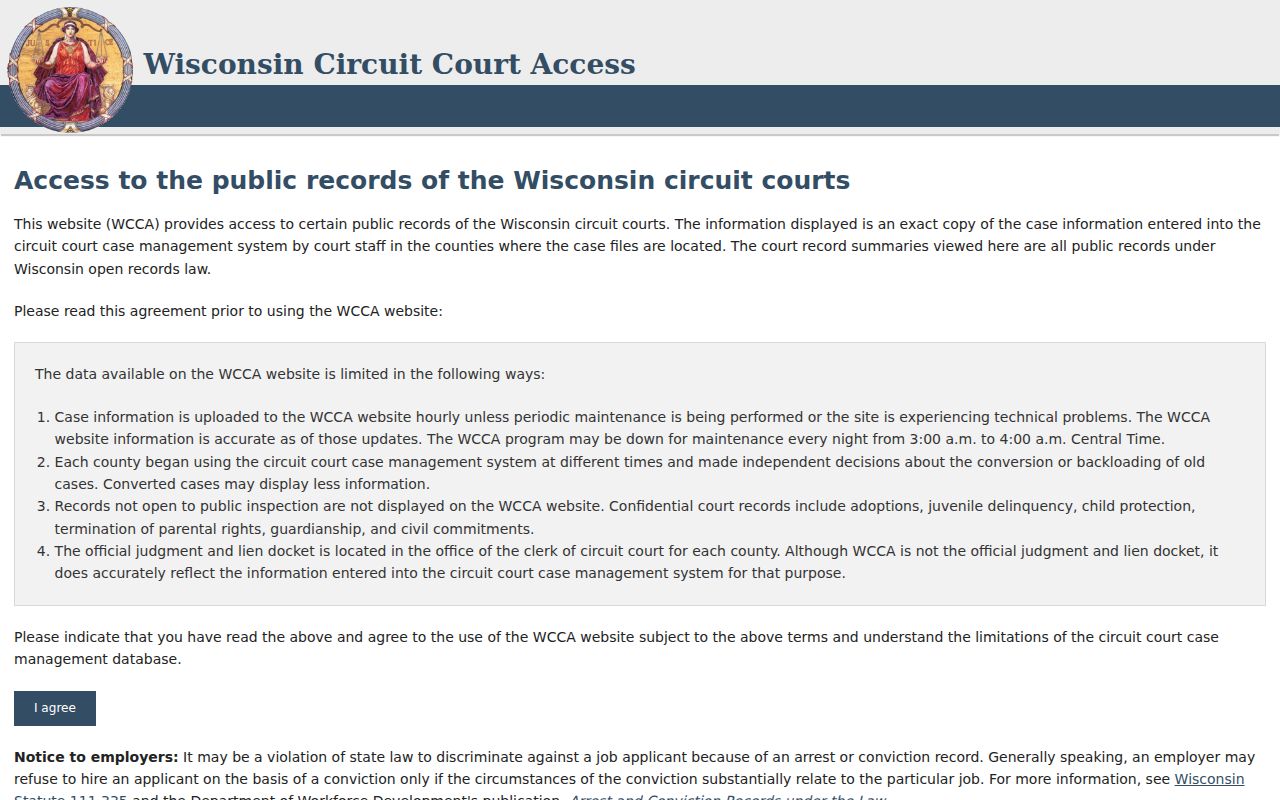
The screen supports case-index research, while the Douglas County courthouse remains the route for records not supplied online.
Resolve Superior Same-Name Matches
A name hit is a lead. It becomes a plausible identity match only when independent fields agree. Compare the printed middle name, date or age range, county, street, parcel key, case role, spouse, employer, business role, or instrument number. Do not merge records because two entries share a surname and city.
Superior adds a geographic trap. The City of Superior, Town of Superior, nearby villages, and unincorporated Douglas County can share postal and county context while using different assessors, zoning offices, election districts, or address authorities. Preserve the postal city and the legal municipality as separate fields. If two records conflict, mark the result as unresolved instead of choosing the newer or more detailed record by default.
Two-anchor rule. Confirm a Superior resident lookup with two independent details beyond the name before joining records into one identity.
Verify One Superior Resident
Use a controlled sequence for a resident lookup. Each step should either confirm a stable key or show why the next source is needed. Stop when the evidence conflicts or when a protected source would be required.
- Write the name exactly as supplied, then list known variants, a date, address, county, and record role.
- Anchor the address to a parcel and tax key, while labeling the owner field as ownership rather than occupancy.
- Search WCCA by name and Douglas County, then compare party role, case year, and any lawful identifying detail.
- Use a vital index, credential, entity filing, directory, or obituary only when it answers a specific identity question.
- Request a certified copy from the responsible custodian when an official copy is needed and eligibility permits it.
- Docket
- The court's chronological list of case events, filings, hearings, and orders.
- Index versus image
- An index describes a record; an image shows the underlying filed or recorded document.
- Certified copy
- An official copy authenticated by the office that keeps the record.
Record the URL, checked date, identifier, exact field match, and any unresolved difference. A current-looking portal result can still describe an old event.
Superior Vital Records by Date
Wisconsin DHS Vital Records keeps state birth, death, marriage, divorce, and domestic-partnership records. Orders may be made by mail, through the approved online or phone vendor, or through an eligible local office. Douglas County Register of Deeds is the local starting point for records it may issue. The state in-person counter was closed in the February 2026 service update, while genealogy research used appointments, so current service status should be checked.
For genealogy, the state reports Douglas County's earliest registrations as birth 1861, death 1877, and marriage 1854. Pre-1907 index work often moves to the Wisconsin Historical Society, where sample entries include county, date, volume, page, microfilm reel, and sequence. Later certificates have eligibility and time rules. Death records under fifty years can be restricted, and a divorce certificate is not the full decree held by the Clerk of Courts.
The DHS application hub shows the separate request paths for each record type.
The application route asks for event and eligibility details; it is not an open search for all people in Superior.
Confirm Superior Civic and Credential Roles
MyVote Wisconsin is a voter-specific tool requiring first name, last name, and date of birth. A self-result can show registration information, voting history, absentee tools, elected officials, and update options. Wisconsin does not register voters by party, so no party label should be inferred. Safe at Home participants can have protected elector information and assigned-address safeguards.
The Wisconsin DSPS license search can verify a credential by profession, credential number, name, organization, or certain trades fields, including ZIP. Results may show status, granted and current-through dates, orders, specialties, and related names. A credential or practice location proves a public professional role, not residence. Wisconsin DFI corporate records serve a similar narrow purpose for legal entities and filing history.
Find Superior Family Connections
Family research should use the official program that matches the relationship. Probate court files and recorded instruments can help identify heirs or estate roles. Historical directories, Superior Times notices, cemetery registers, and vital indexes can connect spouses, parents, dates, and addresses. Each link needs a date because a family connection does not establish current residence.
Wisconsin's Adoption Records Search Program is restricted, not a public name search. Adult adoptees and some eligible relatives may seek non-identifying information. Identifying information generally depends on consent or a qualifying deceased-parent condition. The research states a nonrefundable $40 application fee and an estimated four-to-six-week process. Birth parents generally cannot use this route to request identifying information. Do not attempt to bypass consent or Safe at Home protections.
For a historical endpoint, Riverside Cemetery publishes alphabetic burial lists, while Graceland offers caretaker contact but no public interment database was located. A surname match alone is weak. Pair it with dates, spouse or parent names, a directory address, church, or military detail.
Request Missing Superior Records
When no public portal holds the needed item, send a narrow request to the correct custodian. The City of Superior records system accepts city requests, while the Records Bureau also documents in-person, mail, and phone routes. County land instruments belong with the Register of Deeds or Land Records. Court-file copies go to the Clerk of Courts. Eligible certificates go to DHS or a qualifying local office.
Wisconsin Public Records Law, Wis. Stat. §§19.31-19.39, says requests should be handled as soon as practicable and without delay, but it sets no single response deadline. No special form is required under the DOJ guide. Reproduction, photography, qualifying location, mailing, and necessary direct costs may apply, and prepayment may be required above the stated threshold. Ask for a cost estimate.
- Name the record class, custodian, person or address, and a useful date range.
- Ask for an existing electronic copy, index, or log when appropriate.
- Exclude protected voter, adoption, juvenile, medical, sealed, or safety-program data.
- Save the response, fee estimate, redactions, and any legal reason for withholding.
Superior Resident Lookup Safety Limits
Public access does not make every use fair or safe. Wisconsin Safe at Home protects actual address information through assigned-address rules. Adoption, juvenile, victim and witness, medical, sealed court, driver, and some vital-record information have separate limits. A missing result can therefore mean protected data, a coverage gap, a spelling difference, or a portal failure rather than absence from Superior.
Corrections belong first with the custodian that owns the field. Supply the source URL, record number, printed name or address, date, and the item believed wrong. An archival source may remain unchanged even if a public display is suppressed. Keep the correction request limited and use a safe contact route.
Lawful use. Use a Superior resident lookup only for lawful personal research. Never use names, addresses, court data, or protected clues to stalk, harass, threaten, or harm anyone.
Note: Preserve a checked date because registration, case, custody, license, parcel, and contact records can change after a search.