
Finding Superior Residents Step by Step
Start with the exact text you already hold. Keep the printed name, middle initial, old spelling, address, and date in one place. Retain the street number, direction, suffix, unit, city, state, and ZIP. Superior is both a city and the Douglas County seat. Yet nearby postal addresses may sit in the Town of Superior, a village, or unincorporated land. Confirm that first. It decides whether a city or county office holds the next record.
Treat the Superior residents directory as a set of dated source trails. It is not a single master list. An assessment names an owner, not everyone under the roof. A voter tool serves a voter checking their own registration. A deed lists only the parties to a land transfer. A city directory prints what its publisher gathered for one year. Hold those meanings apart while you follow this starter path:
- Normalize the name or street address, but save the original wording.
- Search the assessment roll by Douglas County, street address, or tax key.
- Use the parcel key to check the map and recorded-document trail.
- Check a name in the appropriate court, license, business, or historical index.
- Record the source, date checked, identifier, and any conflict before drawing a conclusion.
Superior Residents Directory Offices
Several custodians back any Superior residents directory search. The City Assessor and Real Property Lister maintain the assessment side. Douglas County's Register of Deeds keeps deeds, land contracts, mortgages, military discharges, and eligible vital records. The Clerk of Courts handles circuit files. The City Records Bureau routes city requests to the department that owns the material. Ask a named custodian for a specific record. That beats one broad request for everything about a person.
Douglas County Register of Deeds
1313 Belknap St, Room 108
Superior, WI 54880
715-395-1551
Douglas County Clerk of Courts
1313 Belknap St, Room 309
Superior, WI 54880
715-395-1203
The City Clerk sits at 1316 N 14th St, Suite 200, reachable at 715-395-7200 on weekdays from 8:00 to 4:30. For city files, the online records request route is open. Phone, mail, or an in-person request may still fit when the online system does not expose the needed file.
Superior Property Records by Address
The City of Superior links to Assessordata as its free assessment search. The public form asks for a county, then takes either a Property Street Address or Tax Key Number. Search the address first. Copy the parcel key from the matching record. That key opens the later systems. A current card may show the situs address, an owner or mailing address, legal description, land and improvement values, class, and valuation year. None of those fields proves who sleeps there now.
| Search field | How Superior uses it | Limit |
|---|---|---|
| County | Select Douglas County | Separates same street names elsewhere |
| Property Street Address | Finds the parcel by situs address | Mailing address may differ |
| Tax Key Number | Links records with a stable parcel key | Copy it exactly |
The 2025 City of Superior assessment roll supplies a field-level sample. The live portal shifts, and this roll holds steady. It carries owner, tax key, property description, address, district, class, acreage, and value fields. A result can also name a trust, estate, or organization. Follow the legal description and document references. Do not force a personal name onto an entity-owned parcel.
Reading the Superior Parcel Map
The City GIS guide describes public parcel maps, property information, measuring, printing, and map layers. Beacon GIS adds the visual check. Does the selected parcel shape fit the street address? Are nearby lines parcels, roads, or some other boundary? The map orients a search and reveals adjacent parcel IDs, though it is not a legal survey. Superior advises that an official boundary requires a Wisconsin-licensed surveyor.
- Parcel
- A mapped unit of land tied to a tax key.
- Situs address
- The location assigned to the property, which may differ from the owner's mail address.
- Plat
- A recorded map that lays out lots, blocks, or subdivisions.
- Index
- A finding aid that points to a record; it is not always the record image.
Superior's address points were built for emergency dispatch, law enforcement, and land-use work. A point can exist on a vacant parcel. Its label may differ from a postal address. That makes it strong evidence a place is recognized, yet weak evidence about a resident. The detailed address chain belongs in the Superior street directory.
Douglas County Deeds and Superior Names
The Douglas County real-estate records page splits access into several routes. LandShark requires an account, and document images involve a card-payment context. Public terminals at the courthouse offer another option. Tract-index books are not online. Old parcel work may need the counter or a focused request to Land Records. Online image cutoffs also differ by document class. Deeds reach through April 1961, agreements through November 1960, tax deeds through February 1951, and corporations through September 1970.
Enter the chain with the current owner or parcel key. Save each grantor, grantee, instrument number, recording date, document type, legal description, and prior-instrument reference. Work backward one recorded transfer at a time. A deed proves that named parties took part in a recorded transaction. It does not prove that either person occupied the parcel. When the web index stops, the tract book is the next source. Skip repeated searches with new spelling guesses.
See the LandShark entry screen used for Douglas County recorded records.
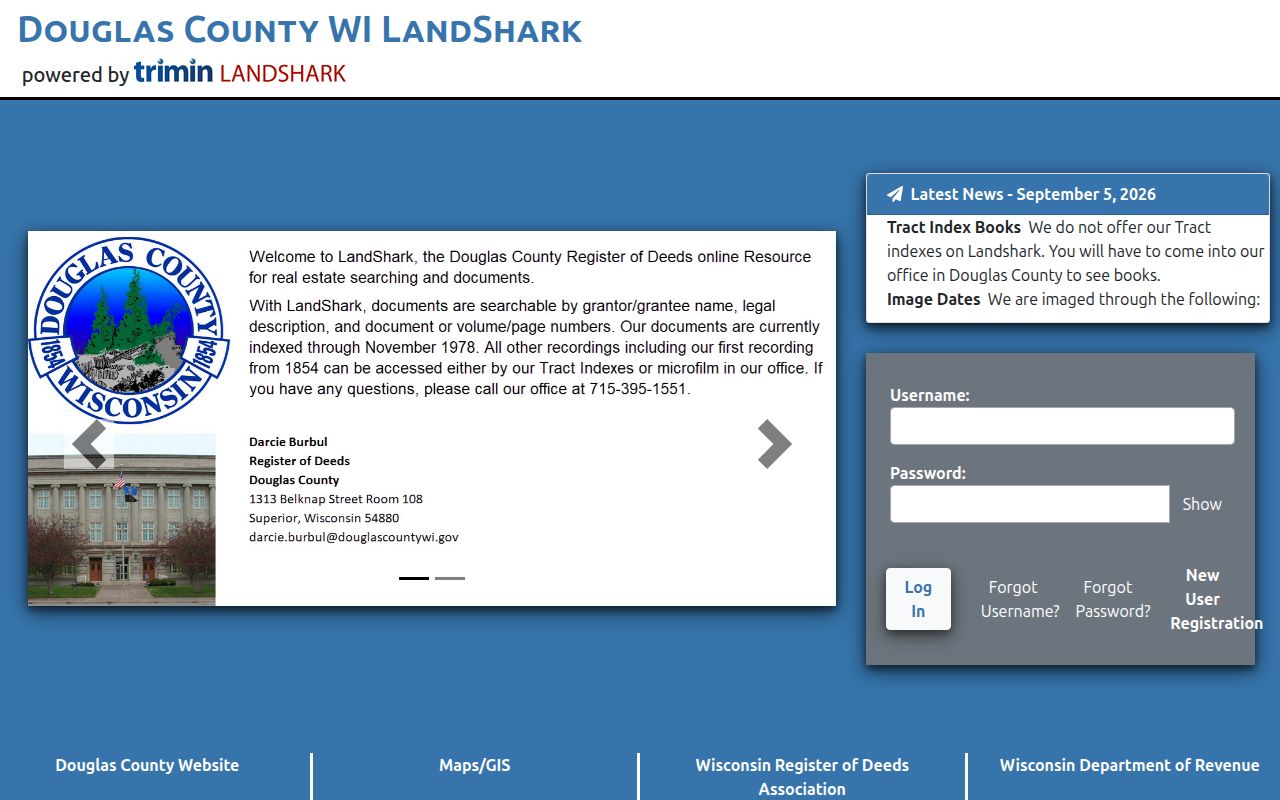
The image shows the county's portal gateway. Its own instructions remain the key source for fees, image cutoffs, terminals, and the offline tract-book path.
Current Superior Residents Directory Sources
Superior has no single roll that lists every current resident. Each source answers a narrower question and carries its own access rules. Grab the source's own identifier, whether a parcel number or case number, so two people sharing a name never blur together in the Superior residents directory.
| Resident source | What it can confirm | Keeper | Access path |
|---|---|---|---|
| Assessment roll | Owner and parcel snapshot | City Assessor | Free search, office help |
| Recorded-document index | Parties and land instruments | Register of Deeds | LandShark, terminal, tract book |
| Circuit case index | Party role and case history | Wisconsin courts | WCCA, courthouse file |
| Voter information | A voter's own status and history | Wisconsin Elections Commission | MyVote or formal data route |
| Credential record | Public license status | Wisconsin DSPS | State license search |
Commercial people-finders fold many record types into one search box. That convenience can bury the original dates. Match logic gets buried too, though. Official systems keep the custodian and the record's purpose in plain view. Errors still creep in. Yet a stable parcel, case, credential, or instrument number gives you something to verify against. Free access sometimes covers only an index. Copies, images, or custom requests are priced separately.
Superior Court Records Need Context
Start with the official Wisconsin case-search landing page. It links to WCCA, the statewide circuit-court index. Searches work by party name, birth date, business name, county, or case number. A result can show the case number and type. It can also show Douglas County designation, filing date, parties and their roles, court events, filing or order titles, status, and disposition. WCCA posts no case documents or transcripts. Those come from the Clerk of Courts at the courthouse. A surname alone won't carry you. Match the county, case type, year, party role, case number, and event sequence. A party listing is not proof of a Superior address. Municipal court sits outside this index entirely, and Superior publishes no public municipal-court search portal. Route a specific citation or file request to the legal custodian. Don't assume the circuit index holds it.
Superior Voter Records Have Boundaries
MyVote Wisconsin exists for voters checking their own records. It asks for a first name, last name, and date of birth. It returns registration details, voting-history items, ballot tools, elected officials, and address-update functions. It is not a reverse-address directory. Wisconsin registers no party affiliation. Any Superior residents directory built from this data must leave that field blank. Public voter data travels a different route, through the Wisconsin Elections Commission under Wis. Stat. §6.36. Protected fields include birth dates, driver-license and Social Security numbers, Safe at Home details. Also protected is any address tied to an identification-card serial number. Poll lists can also be requested from a municipal or county clerk at reproduction cost. Confirm the current fee terms before ordering. The commission publishes no single flat fee table. The MyVote lookup form shows why this search stays personal and field-specific.
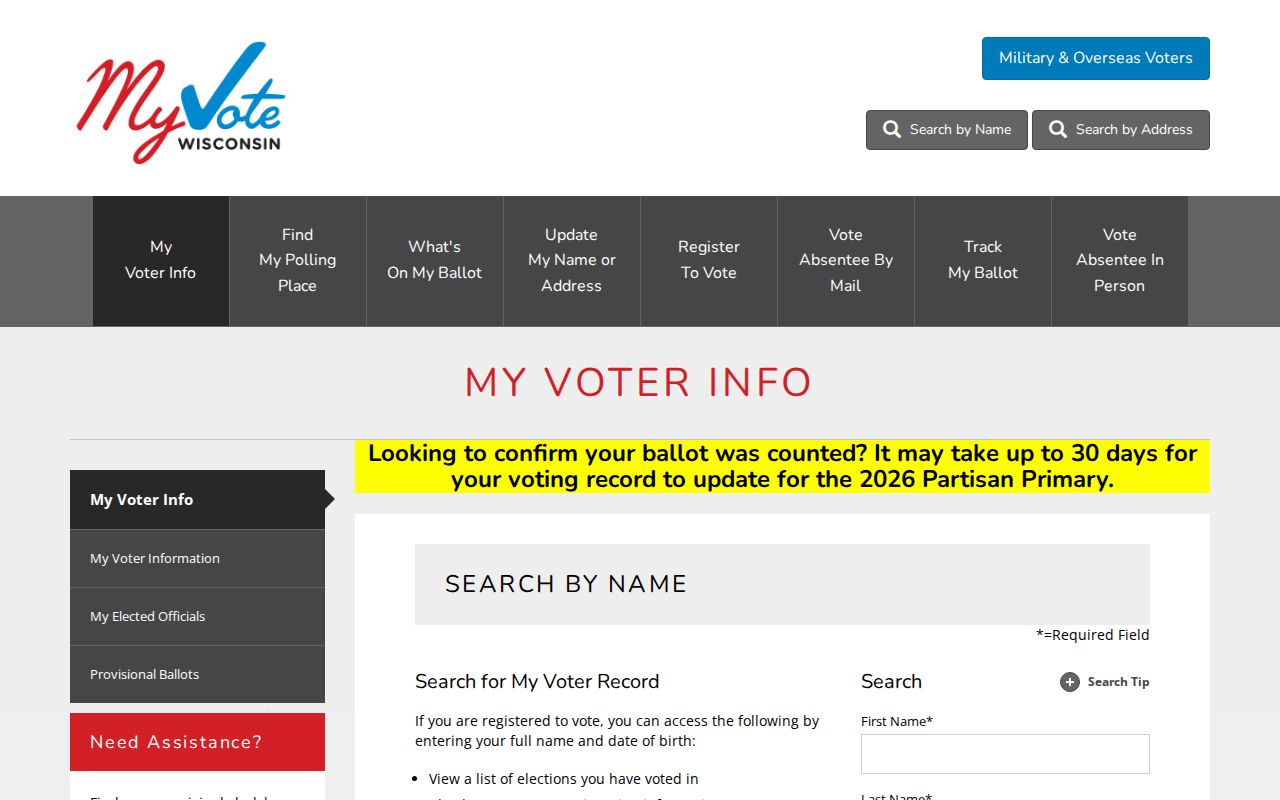
The form asks for the voter's own identity details. It is the wrong tool for assembling a roster of people at one Superior street address.
Requesting Superior Records Not Online
Wisconsin Public Records Law, Wis. Stat. §§19.31-19.39, covers records made or kept for public business. It is shaped by statutes, common-law limits, and a public-interest balancing test. No magic words are required. No special form exists either. The request just needs enough subject and time detail to be understood. A custodian should respond as soon as practicable and without delay. The law fixes no number of days. The City Records Bureau takes requests online, in person, by mail, or by phone. It routes them to the right department. Its City Archive searches by category, keyword, archive, time period, and start or end date. Douglas County offices run separate paths for deeds, tax data, court files, and vital records. If a request draws no reply, keep a dated copy and follow up. Silence is not a denial.
- Name the exact record class and Superior or Douglas County custodian.
- Give a case, parcel, instrument, date range, or other stable key.
- Ask for electronic inspection when that will meet the need.
- Request an estimate if copies, research, or location work may create a fee.
- Log the response, denial reason, redactions, and next office named.
Superior Residents Directory Through Time
The Douglas County Historical Society shelves Superior city directory volumes starting with 1889-90 and 1892-93, then annual or near-annual books through 1906. Later holdings span 1914-35 and 1937-55, with frequent volumes from 1957-98, plus 2000, 2001, and 2003. Mind the gaps. A missing year in that inventory does not mean no directory was published. It means the shelf lists none. Superior Public Library holds local newspapers, census rolls, directories, naturalization records, an index reaching back to the 1850s, clippings, and printed material. Requests go in person, by phone, email, or through its research form. They are answered in order, with no promised turnaround. Local-history help runs Tuesdays from 10:00 to noon and Thursdays from 1:00 to 3:00, including microfilm-reader assistance. Duluth Main Library adds another collection locator, with Superior directories from 1922 to 2014 available in person and through its genealogy subscription. Some early books bind Duluth and Superior together. Check a shared regional title before deciding a Superior volume is absent. The Superior city directory walkthrough covers the full shelf and how to read it.
Superior Times Bridges Missing Years
The Library of Congress holds the weekly Superior Times from 1870 through 1912. That digitized span fills gaps on the directory shelf. A dated legal notice, obituary, or social item can anchor a name or business. But a street directory may have missed it. Newspapers err too, though. They misspell names and repeat stale addresses. Save the issue date and page. Then pair the clipping with a directory, vital index, deed, or plat before trusting it as part of the Superior city directory record.
Vital records need the same caution. The Wisconsin Historical Society notes that county registration began in 1852. But it stayed weak until about 1880. Its state table starts Douglas County marriages in 1854. Births begin in 1861, and deaths in 1877. A vital index may name an event without any residence at all. Treat a jump from event to present parcel as mere inference. A deed, directory, map, or other dated bridge must support it first.
The local Historical Society's own history shows why gaps mislead. An account from 1902 claimed no collection existed and meetings came only every four years. The group reorganized in 1931 and went countywide in 1934. Early absence often reflects what survived, not who lived in Superior.
Superior Identity Checks Beyond Addresses
A business filing or professional credential can pin down a name without claiming a home address. The Wisconsin Department of Financial Institutions runs a corporate search. It spans current and historical entity filings. Results may list the legal entity name and status. Entity type, filing date, state, registered office, and filing history may appear too. Coverage has limits. It does not promise every member, trade name, phone number, or federal tax number. Grab the entity ID and filing date. That separates similarly named organizations.
The Wisconsin Department of Safety and Professional Services takes a different angle. It searches individuals, organizations, and trade credentials. A trades search can filter by credential type, status, ZIP, and name. Status refreshes hourly and generally runs current within a day. Keep the profession and credential number attached to any result you save. Include the status, grant or expiration details, and discipline links too. One warning matters here. A professional mailing or business address is not a Superior home. The residents directory record should never relabel it as one.
Custody and registry searches deserve the most care. The Douglas County Sheriff roster covers current, latest, and released jail records. Wisconsin DOC covers the state prison population. The sex-offender registry carries its own statutory scope and warns against harassment. A roster or registry entry is not a citywide resident roll. Keep it in its original category.
Keep Superior Directory Findings Auditable
Every useful finding deserves a small record card. Log the category, the subject name as printed, and any normalized name. Add the address as printed plus its normalized form, parcel or tax key, jurisdiction, source title and URL, publication or event date, coverage period, record identifier, access status, and checked date. Flag privacy when a source holds protected or sensitive material. State confidence plainly. Call a finding consistent, plausible but unconfirmed, or not enough evidence.
Compare text only through stable keys. Use the parcel key, instrument number, case number, credential number, vital index volume or page, and directory year or page. When two sources disagree, mark the conflict instead of smoothing it over. The assessor may hold a situs address. The deed uses a legal description. The owner's mail may go elsewhere. An old street directory may preserve an earlier street form. Never average these values or quietly pick the newest one.
Safe at Home sets a firm boundary. Participants are confidential electors, and agencies use an assigned address while shielding the real one. Adoption, juvenile, victim and witness, sealed-court, driver, and recent vital records all carry limits too. A failed search must never become an attempt to dodge those protections. That discipline keeps a Superior residents directory honest. It serves family history, civic research, estate questions, and personal record checks. It never builds an unsafe profile from scattered public files.