
Superior Previous Resident Sources
Start with the source closest to the chosen year. A recent Superior address can be anchored in an assessment roll and deed. Earlier previous residents are more likely to appear in city directories, newspapers, census schedules, plats, or vital indexes. Every source has a different link to the property, so record whether it proves title, a printed address, a household, or just a name associated with the area.
| Source | Dated reach | Local access point | Evidence found |
|---|---|---|---|
| Assessment rolls | 2021 to 2025 PDFs | City Assessor website | Owner, tax key, property address, class and values |
| Recorded instruments | Image cutoffs vary by type | LandShark and Register of Deeds office | Title parties, dates, document number, legal description |
| City directories | Local run begins in 1889; holdings extend to 2003 | Historical Society and regional libraries | Dated names and printed addresses |
| Superior Times | 1870 to 1912 | Digitized newspaper collection | Legal notices, obituaries, social and street references |
| Pre-1907 vital indexes | Douglas registrations begin by record type | Wisconsin Historical Society and microfilm | Name, event, county, volume, page and reel clues |
A roll series is best for recent parcel changes. The deed chain reaches farther but follows owners. Printed sources help answer who lived here before. For the nineteenth and early twentieth centuries, expect to combine several collections because no continuous address roster exists.
Reverse Douglas County's Deed Chain
The current parcel gives a stable starting point for Superior previous residents research. Search the owner and legal description in Douglas County records, then walk each transfer backward. Instrument dates and recording dates can differ, so keep both. A seller's earlier purchase is often found by searching that person or entity as a grantee.
- Find the current tax key, owner, situs address, and legal description in Assessordata or the annual roll.
- Locate the current purchase instrument in LandShark and save its document number and parties.
- Search the grantor as a grantee to find the prior acquisition, checking initials, trusts, estates, and entity names.
- Repeat with each earlier instrument while matching the legal description, parcel key, and prior references.
- When online images stop, use the public courthouse terminal, tract-index books, Land Records staff, and archival abstracts.
- Grantor and grantee
- The grantor transfers an interest; the grantee receives it.
- Chain of title
- The linked sequence of recorded interests in one property.
- Legal description
- The land description in a deed, often more durable than a street number.
- Correction instrument
- A record that fixes indexing or description text and may not show a new sale.
A transfer-on-death form or termination of a decedent's interest may shift title outside the pattern of a routine purchase. Do not fill an occupancy column from a deed alone. Title and residence remain separate questions.
Superior's Tract-Book Break
Douglas County states that tract-index books are not available in LandShark. Deed images extend through April 1961, agreements through November 1960, tax deeds through February 1951, and corporation records through September 1970. Those dates describe online image reach, not the creation or survival of the underlying records.
The correct fallback for an older parcel is the Register of Deeds or Land Records office. Public terminals are available onsite, and genealogy searches can be requested Monday through Friday from 8:00 a.m. to 4:30 p.m., except holidays. Land Records can be reached at 715-395-1570 or landrecords@douglascountywi.gov.
The successful capture of Douglas County real-estate instructions marks this online-to-office break:
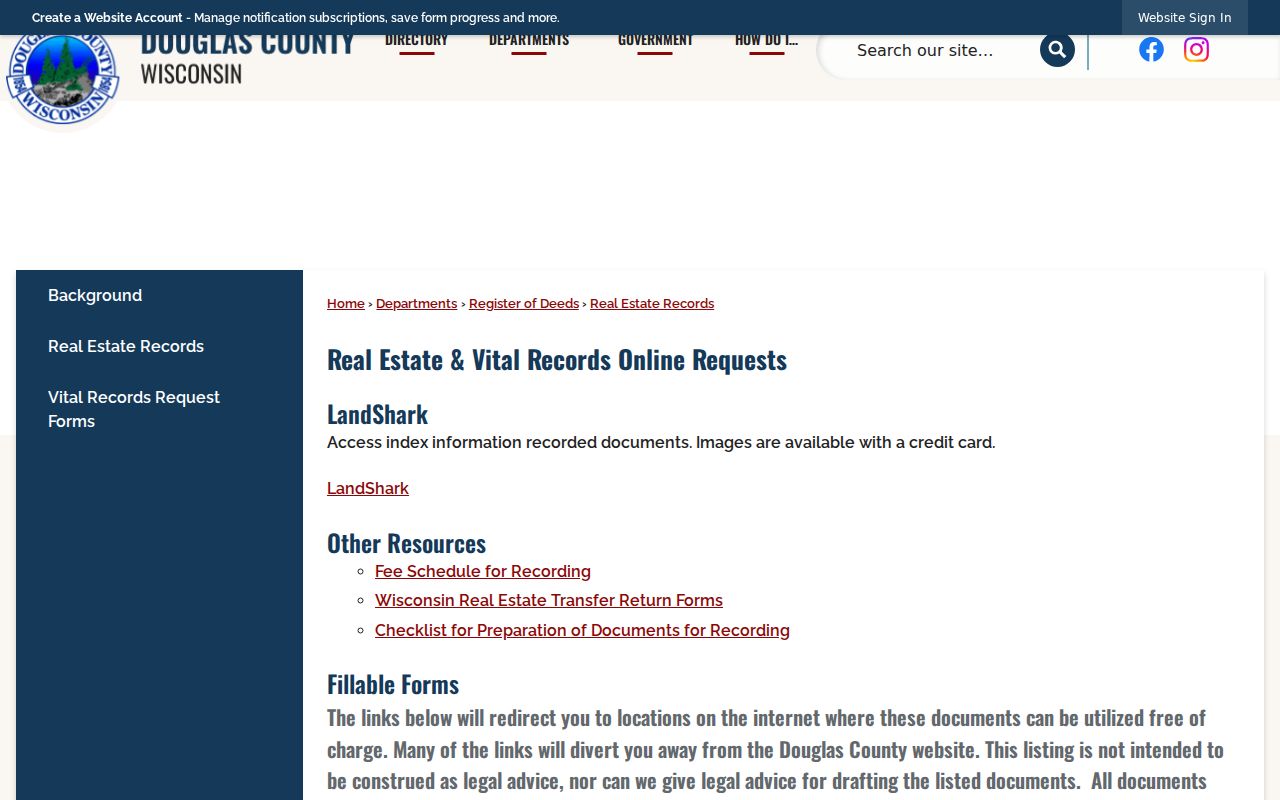
Use its current cutoff notes before deciding that an earlier deed or previous owner cannot be found.
Choose a Superior Directory Year
Pick the target year before picking a person's name. Douglas County Historical Society holdings begin with an 1889 volume and include an 1889 to 1906 early run, with gaps across later decades and holdings extending through 2003. Duluth Public Library's collection locator reports Duluth and Superior directories from 1922 to 2014. Some early volumes bind the two cities together.
A directory entry is a dated clue, not proof of residence for the full year. Publication work can lag a move, names may be abbreviated, and a business listing may look like a household entry. For details on the volumes and how entries are arranged, consult the Superior city directory collections.
Search both the name and address arrangement when available. Preserve spelling, initials, street direction, and number exactly as printed. If no volume survives for the year, move to a nearby directory, newspaper, census, or archive record rather than treating the silence as an empty house.
Superior Library Bridges Record Gaps
The Superior library research service lists local newspapers, census rolls, city directories, and naturalization records. A request should name the person, address as printed, date range, and exact record type. The source page was successfully captured, but service terms can change.
Review the library's reference-material request route before submitting a focused query:
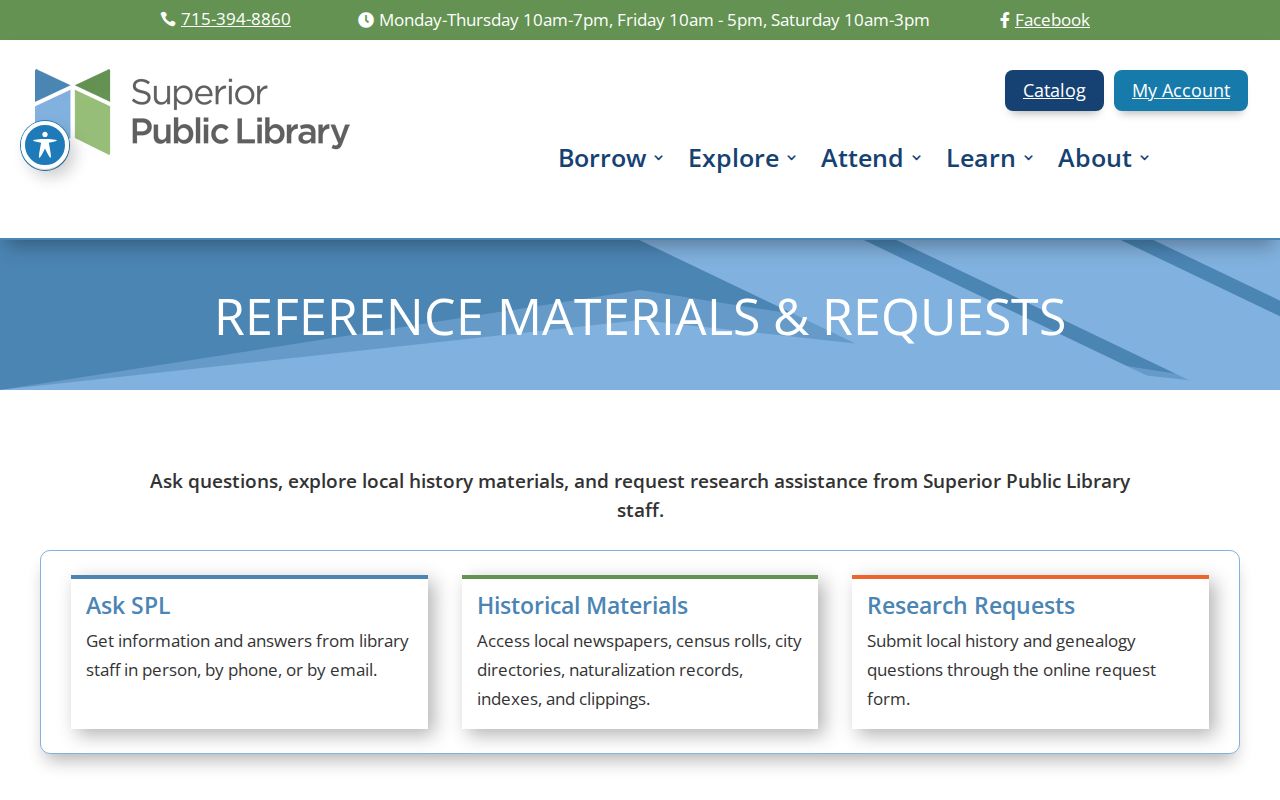
The listed mix of directories, newspapers, census material, and naturalization records gives several ways to test one address without claiming that any single item is complete.
Local-history drop-in help was advertised on Tuesdays and Thursdays in February 2026, including microfilm-reader instruction. Check the current calendar before visiting. Hands-on reader help can be more useful than a broad remote request when several spellings or years must be tested.
Superior Times Fills Early Gaps
The digitized Superior Times spans 1870 through 1912 and can bridge years when no directory volume is present. Search a street, surname, business, estate, legal notice, obituary, or civic project. Newspaper spelling and address forms vary, and repeated print mentions can all stem from the same original notice.
Pair each item with a deed, directory, vital index, census record, or dated map. A legal notice may establish a property interest. An obituary can name kin or a former address. Neither should be stretched into proof of who occupied the building on an unrelated date.
Preserve Old Superior Addresses
No official Superior street-renumbering or renaming chronology was found. Preserve each historical address exactly as printed, then put a proposed modern form in a separate field. A current GIS point that looks close is not enough to declare the two addresses identical.
Test the link with a dated plat, deed legal description, directory cross-reference, council item, or Public Works record. The Historical Society's Box 25 holds atlas and plat books, Box 79 lists deeds and abstracts, and Boxes 88 and 207 include public works material. The city archive accepts keywords, archive categories, and date ranges, so an old street name or nearby project can explain a change.
Pair Superior Households by Decade
Owners form only one layer of the address history. A directory can place a named adult at a printed address, while a federal census can show a household and relationships within the released schedule. Use the directory year nearest the census, but do not assume every person stayed in place between them.
A compact process keeps the claim honest: printed address → nearest directory year → matching census place and household → next directory year → independent news, vital, or parcel record. Record name variants and the source date at every step.
Naturalization records can help distinguish same-name residents. Pre-1907 Wisconsin Historical Society index entries add county, event date, volume, page, reel, and sequence. The full image may still require microfilm or onsite access.
Close Superior Resident Trails Carefully
An obituary, probate file, cemetery register, or vital index may explain when previous residents left an address or connect them with relatives. Riverside Cemetery offers alphabetic burial PDFs, while Calvary and St. Francis are identified by the Diocese of Superior. No public Graceland interment database was located.
Use the cemetery operator's record when a correction matters. A shared surname is not enough to build a family link. Compare dates, spouse or parent names, military or church clues, and a directory address. Burial in Superior does not prove that the person lived at the researched house.
Limits on Superior Previous Residents
A previous residents search can establish a dated chain of evidence, not a complete roll of every person who stayed at an address. Missing volumes, uneven early registration, alternate spellings, municipal boundaries, and records held only in person all create gaps. An assessment owner may be an estate, trust, organization, or mailing agent.
Keep a research card with the name and address as printed, normalized versions, parcel key, jurisdiction, source, date, access status, field match, confidence, and unresolved conflict. That record makes later corrections possible and prevents a modern address from being silently inserted into an old source.
Lawful use. Research past residents for house history, genealogy, heirs, or personal curiosity, and never use the findings to track, stalk, or harass a living person.